Labor strikes have been a powerful tool for American workers for over a century, giving employees leverage to negotiate better wages, safer conditions, and stronger benefits. But when you walk off the job in a labor dispute, one question inevitably comes up — can you still collect unemployment benefits while on strike? The answer depends on several factors, including your state, the type of dispute, and whether you are truly on strike or have been locked out by your employer.
Understanding the relationship between strikes and unemployment insurance is essential for any worker considering participation in a labor action. The rules are not always intuitive, and they vary significantly from state to state. In this guide, we will break down exactly when striking workers can and cannot receive benefits, how lockouts differ from strikes, and what steps you should take if you find yourself unemployed during a labor dispute.
The General Rule: Striking Workers Usually Cannot Get Benefits
Under federal law and the majority of state unemployment systems, workers who voluntarily participate in a strike are generally disqualified from receiving benefits. The reasoning is straightforward — unemployment insurance is designed for people who lose their jobs through no fault of their own, and choosing to walk off the job in a strike is considered a voluntary separation.
Most states explicitly address strikes in their unemployment statutes. When you file a claim and the agency learns you left work due to a labor dispute, they will typically deny your application. This denial applies for the duration of the strike, and in many states, it extends for a set period even after the strike ends.
However, there are important exceptions to this general rule, and understanding them can make the difference between having some income during a difficult time and having none at all. The key distinctions involve lockouts, non-striking workers, and specific state provisions.
Lockouts vs. Strikes: A Critical Distinction
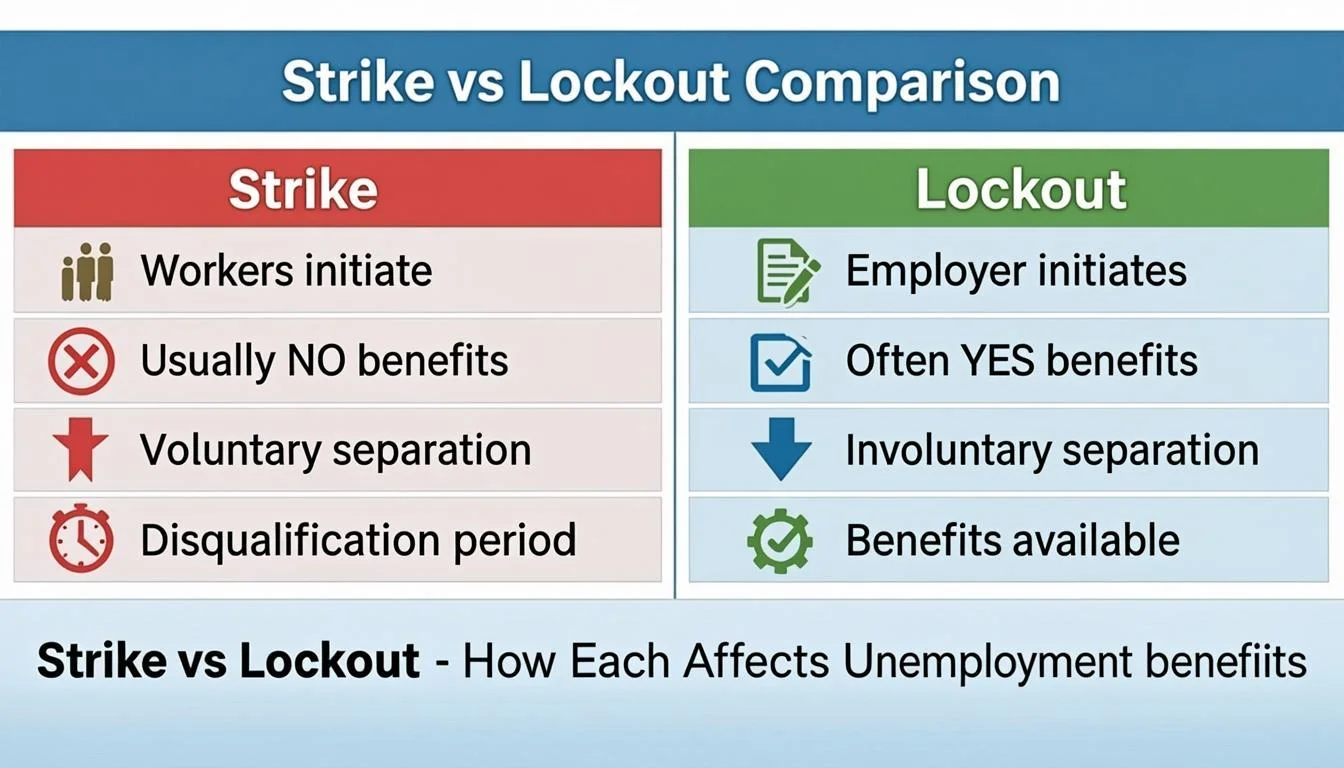
The most important exception to the strike disqualification rule involves lockouts. A lockout occurs when the employer — not the workers — initiates the work stoppage by preventing employees from entering the workplace. This commonly happens during contract negotiations when the employer wants to force concessions from the union.
In most states, workers who are locked out by their employer CAN receive unemployment benefits. Because the work stoppage was initiated by the employer rather than the employees, the situation is treated similarly to a layoff — the workers are unemployed through no fault of their own.
Determining whether a situation constitutes a strike or a lockout can be legally complex, especially in cases where both actions occur in sequence. If workers initially strike and the employer then locks them out, some states will still treat the entire period as a strike-related disqualification. Other states will switch the classification once the lockout begins, making workers eligible from that point forward.
How to Tell If It Is a Lockout
Several factors help determine whether a work stoppage is a lockout rather than a strike. The employer has changed the terms of employment without reaching an agreement. The employer physically prevents workers from accessing the workplace. The employer has hired replacement workers. The employer has unilaterally imposed new conditions that are less favorable than the previous contract.
If you believe you have been locked out rather than placed on strike, document everything carefully. Keep copies of any communications from your employer, photographs of locked gates or facilities, and records of any replacement workers being brought in. This documentation will be critical when you file your unemployment claim.
Non-Striking Workers During a Labor Dispute
What happens if you are not participating in the strike, but you cannot work because the strike has shut down your workplace? This is another situation where the rules get nuanced, and different states handle it differently.
Some states allow non-striking workers to collect benefits if they are unable to work because of a strike they did not participate in. The logic is that these workers are effectively laid off — they are willing and able to work, but the employer cannot operate because of the labor dispute. This is particularly relevant for non-union workers at a facility where union members are striking.
Other states disqualify ALL workers at a struck establishment, regardless of whether they personally joined the picket line. These states view the labor dispute as affecting the entire workplace, and they deny benefits to everyone until the dispute is resolved. If you are a non-union employee caught in this situation, check your state specific rules carefully.
State-by-State Variations in Strike Rules
Because unemployment insurance is administered at the state level, the rules governing benefits during labor disputes vary considerably. Understanding your state specific position is crucial before making decisions about participating in a strike or filing for benefits.
States That May Allow Benefits During Lockouts
The majority of states allow benefits during employer-initiated lockouts. This is the most worker-friendly provision in the unemployment system when it comes to labor disputes. States like New York, California, and Michigan have strong protections for locked-out workers, treating them as effectively unemployed through employer action.
Some states also make a distinction between economic strikes — where workers are fighting over wages and benefits — and unfair labor practice strikes — where the employer has violated labor law. In an unfair labor practice strike, some states will allow workers to receive benefits because the employer is at fault for violating the National Labor Relations Act.
States With Strict Disqualification Periods
Many states impose a disqualification period that extends beyond the end of the strike. For example, a worker might be ineligible for benefits not only during the strike but also for several weeks after returning to work. This extended disqualification acts as a deterrent against using voluntary work stoppages as a financial strategy.
A few states have particularly harsh provisions that can disqualify striking workers from receiving any benefits for the entire benefit year, not just the period of the strike. These states include some in the South and Midwest where labor protections are traditionally weaker.
Filing for Benefits During a Labor Dispute
If you believe you may qualify for unemployment benefits during a labor dispute, the process for filing is the same as for any other claim — but you should be prepared for additional scrutiny.
Be Honest About the Circumstances
When you file your claim, you will be asked about the reason for your unemployment. Answer honestly. If you are on strike, say so. If you have been locked out, say so. Lying about the circumstances of your unemployment is benefit fraud, and the penalties can be severe — including repayment of all benefits received, fines, and even criminal prosecution.
Prepare for a Fact-Finding Interview
Most state agencies will schedule a fact-finding interview when a labor dispute is involved. During this interview, an adjudicator will ask detailed questions about the nature of the work stoppage, your role in it, and whether you believe you should be eligible for benefits. Having documentation ready — union communications, employer notices, and any evidence of a lockout — will strengthen your case.
Know Your Appeal Rights
If your claim is denied because of a labor dispute, you have the right to appeal. Many workers win their appeals, especially in lockout situations or when they can demonstrate they were not voluntary participants in the strike. Learning how to appeal an unemployment denial is worth the effort, as the appeal process often results in a more thorough review of the facts.
Replacement Workers and Unemployment
During strikes, some employers hire permanent replacement workers. If you are replaced during a strike and the employer has no position for you when the dispute ends, this creates a unique situation for unemployment benefits. In many states, once you have been permanently replaced, you are no longer considered voluntarily unemployed — you have effectively been terminated.
At that point, you may become eligible for benefits even though the work stoppage began as a strike. The key factor is whether your employer still has a job available for you. If they do not, your status shifts from striker to displaced worker, and the normal rules of termination and eligibility apply.
Practical Tips for Workers in Labor Disputes
If you are involved in or considering a labor dispute, these practical steps can help protect your financial situation.
- Build an emergency fund: Before any labor action, save enough to cover your expenses for the expected duration plus a buffer. Unemployment benefits, even if available, will not replace your full income.
- Understand your union strike fund: Most unions provide strike benefits to members during labor disputes. These payments are separate from unemployment insurance and can provide a financial bridge.
- Document everything: Keep records of all communications from your employer and union. If a lockout occurs, document it immediately. This evidence supports both your unemployment claim and any future legal proceedings.
- File promptly: Even if you are unsure whether you qualify, file your claim as soon as possible. Backdating is sometimes possible but not guaranteed.
- Consult your union representative: Your union likely has experience navigating unemployment claims during labor disputes. They can provide guidance specific to your situation and your state.
The Bigger Picture: Labor Rights and Economic Security
The tension between the right to strike and access to unemployment benefits reflects a broader debate about worker protections in America. Unemployment insurance was designed to provide economic security during involuntary job loss, but labor disputes blur the line between voluntary and involuntary separation.
As the labor landscape continues to evolve — with rising union activity, new forms of work organization, and increasing economic uncertainty — the rules governing benefits during labor disputes may also change. Staying informed about your rights and your state current provisions is the best way to protect yourself during any work stoppage.
Whether you are a union member considering a vote to authorize a strike, a non-union worker caught in a labor dispute, or an employee facing a lockout, understanding how unemployment benefits interact with labor actions empowers you to make informed decisions about your financial future. The system has provisions that can help in certain situations, but only if you know they exist and take the right steps to access them.