When your employer hands you a severance package on your way out the door, it can feel like a small lifeline — a cushion of cash that helps bridge the gap between jobs. But that same severance check can create a complicated problem: does it reduce or delay your unemployment benefits? The answer depends on where you live, how your severance is structured, and when you receive it. Some states treat severance as wages that directly offset your unemployment benefit, while others ignore it entirely. The difference can be worth hundreds or even thousands of dollars over the course of your claim, so understanding the rules in your state is not optional — it is essential.
The confusion around severance and unemployment is understandable. Both are forms of income that replace your lost wages, and the idea that you might not be able to collect both at the same time feels unfair. After all, you earned that severance through years of service, and unemployment insurance is a benefit you paid into through payroll taxes. But the unemployment system is designed to replace wages only when you have no other income source, and severance is considered income in many states. This guide breaks down exactly how each state handles severance, the difference between lump-sum and periodic payments, and strategies to maximize your total income during the transition. If you are just starting the process, our complete application guide covers the initial filing steps.
Why Severance Pay Affects Unemployment Benefits
The fundamental principle behind unemployment insurance is straightforward: it replaces a portion of your lost wages when you become unemployed through no fault of your own. The system is not designed to supplement your income on top of other wage-replacement payments. When you receive severance pay, many states view it as a continuation of your wages from your former employer, even though you are no longer working. This means that the weeks covered by your severance are treated as if you are still receiving wages, and your unemployment benefit is either reduced or delayed until the severance period ends.
The logic makes sense from the state's perspective: if your employer is still paying you through severance, you are not fully unemployed during that period. The unemployment system is designed as a safety net for people who have no income, not a bonus for people who already have severance. However, the way this principle is applied varies dramatically from state to state, and the distinction between lump-sum and periodic severance payments creates an additional layer of complexity. Understanding how your state treats severance is critical because it determines whether you should file for unemployment immediately or wait until your severance period ends. For more on eligibility requirements, see our eligibility guide.
Lump-Sum vs. Periodic Severance: The Critical Difference
The single most important factor in determining how severance affects your unemployment benefits is the way the severance is paid. There are two main types: lump-sum payments and periodic payments. A lump-sum severance is a one-time payment that you receive all at once, typically within a few weeks of your termination. A periodic severance is paid out over time, usually in regular installments that mirror your previous pay schedule. The distinction matters because most states treat these two types of severance very differently.
In states that reduce benefits for periodic severance, the logic is clear: if you are receiving a severance check every two weeks that replaces your regular wages, you are effectively still employed from the state's perspective. Your unemployment benefit is reduced or eliminated for each week that you receive a severance payment. Once the severance payments stop, your full benefit kicks in. This is the most common approach in states that offset benefits for severance, and it is relatively straightforward to understand and plan for.
Lump-sum severance is where things get complicated. Some states treat a lump-sum payment as if it were spread out over a period of weeks, based on your previous weekly wage. For example, if you received a $10,000 lump-sum severance and your weekly wage was $1,000, the state might treat it as if you received severance for 10 weeks, even though you received it all at once. This can delay your unemployment benefits for months, which is a significant financial impact. Other states treat lump-sum severance as a one-time payment that does not affect your weekly benefit at all, allowing you to collect both severance and unemployment simultaneously. This is one of the biggest differences in how states handle severance, and it can mean the difference between receiving your full benefit immediately and waiting months for it to begin. For a detailed breakdown of how benefits are calculated, see our benefit formula guide.
State-by-State Severance Rules
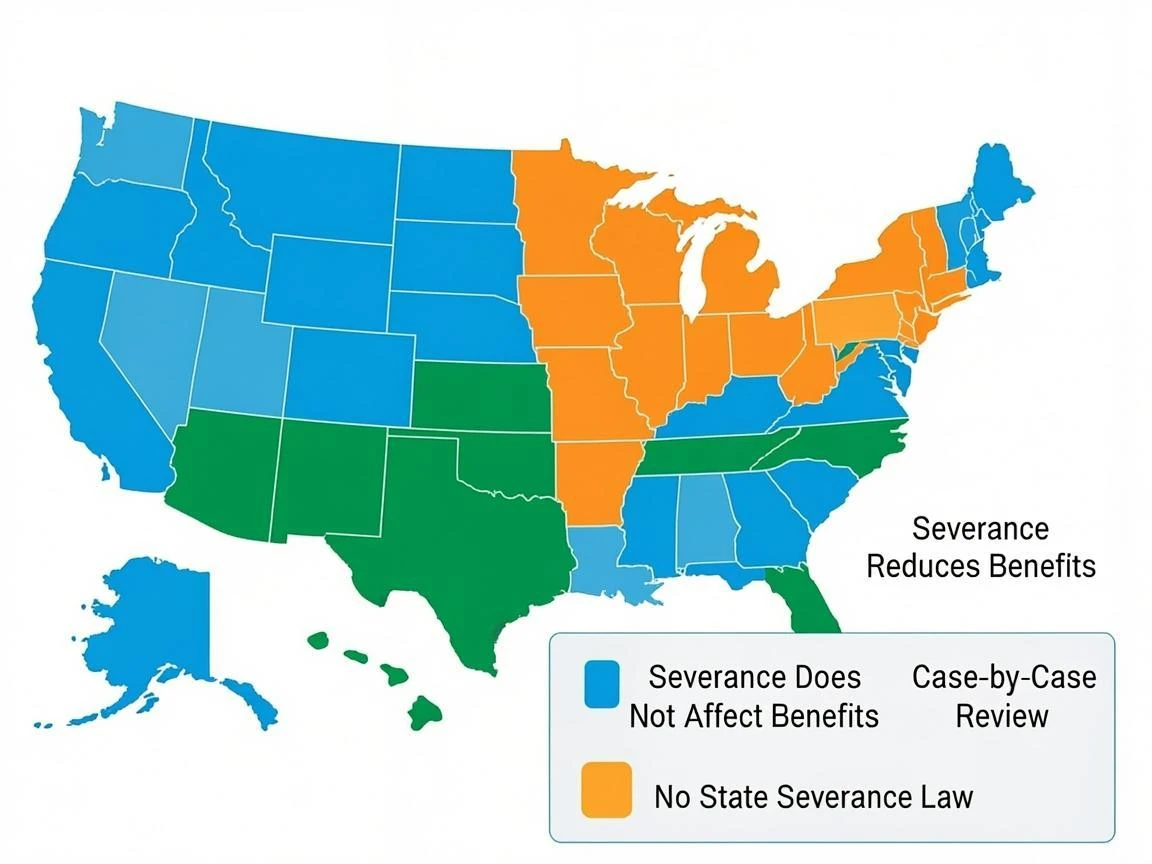
The following table shows how each state treats severance pay in relation to unemployment benefits. This is a critical reference for anyone receiving severance, because the rules in your state will determine whether you should file for unemployment immediately or wait until your severance period ends. Keep in mind that these rules are subject to change, and you should always verify the current rules with your state's unemployment agency before making decisions.
| State | Lump-Sum Treatment | Periodic Treatment | Key Rule |
|---|---|---|---|
| Alabama | No offset | Offsets benefit | Periodic severance treated as wages |
| Alaska | No offset | Offsets benefit | Periodic payments delay benefits |
| Arizona | No offset | Offsets benefit | Continuation pay treated as wages |
| California | No offset | Offsets benefit | Lump-sum does not affect benefits |
| Colorado | Allocated over weeks | Offsets benefit | Lump-sum may be allocated by state |
| Connecticut | No offset | Offsets benefit | Lump-sum severance excluded |
| Florida | No offset | Offsets benefit | Periodic severance delays filing |
| Georgia | Allocated over weeks | Offsets benefit | Severance allocated by weekly wage |
| Illinois | No offset | Offsets benefit | Lump-sum does not reduce benefits |
| Indiana | No offset | Offsets benefit | Periodic payments treated as wages |
| Massachusetts | Allocated over weeks | Offsets benefit | Lump-sum allocated by agreement terms |
| Michigan | No offset | Offsets benefit | Lump-sum severance excluded |
| Minnesota | Allocated over weeks | Offsets benefit | All severance allocated by state |
| New Jersey | No offset | Offsets benefit | Lump-sum does not affect benefits |
| New York | Allocated over weeks | Offsets benefit | Severance allocated by weekly wage |
| North Carolina | No offset | Offsets benefit | Periodic severance delays benefits |
| Ohio | No offset | Offsets benefit | Lump-sum severance excluded |
| Pennsylvania | Allocated over weeks | Offsets benefit | Severance allocated per agreement |
| Texas | No offset | Offsets benefit | Lump-sum does not reduce benefits |
| Virginia | No offset | Offsets benefit | Periodic severance delays filing |
| Washington | No offset | Offsets benefit | Lump-sum severance excluded |
| Wisconsin | Allocated over weeks | Offsets benefit | Severance allocated by weekly wage |
Severance Agreement Types That Affect Your Benefits
Not all severance agreements are the same, and the specific language in your agreement can determine whether your benefits are affected. The three most common types of severance arrangements are salary continuation, severance in lieu of notice, and voluntary separation incentives. Each has different implications for your unemployment claim.
Salary continuation is the most straightforward type. Under this arrangement, your employer continues to pay your regular salary for a set period after your termination date. You remain on the payroll, receive your regular paychecks, and may even keep your benefits. Most states treat salary continuation as ongoing employment, which means you cannot collect unemployment benefits while receiving it. Once the salary continuation period ends, you become eligible for benefits as long as you meet all other requirements. If you are in a salary continuation arrangement, do not file for unemployment until the period ends — filing early will result in a denial and may complicate your claim.
Severance in lieu of notice is a lump-sum payment that your employer gives you instead of providing advance notice of your termination. Under the federal WARN Act, employers with 100 or more employees must give 60 days notice before a mass layoff or plant closing. If they do not, they must pay you for those 60 days. Some states treat this payment as wages for the notice period, which means it can delay your unemployment benefits. Others treat it as a separate severance payment that does not affect your benefits. The distinction depends on your state's specific rules and the language in your severance agreement. Our severance pay guide provides additional details on how these agreements work.
Voluntary separation incentives are payments that employers offer to encourage employees to resign voluntarily, typically during downsizing or restructuring. These payments are often treated differently from regular severance because they are not required by law or contract — they are an incentive to leave. Some states treat voluntary separation incentives as severance that offsets benefits, while others treat them as a separate payment that does not affect unemployment. If you accepted a voluntary separation package, check your state's rules carefully, because accepting voluntary separation may also affect your eligibility for benefits under the "voluntary quit" rules. For more on this, see our voluntary quit guide.
Strategies to Maximize Your Total Income
If you are receiving severance and planning to file for unemployment, there are several strategies you can use to maximize your total income during the transition. The most important strategy is to understand your state's rules before you make any decisions. If your state treats lump-sum severance as a non-offsetting payment, you can collect both your severance and your full unemployment benefit simultaneously — this is the best-case scenario. If your state allocates lump-sum severance over weeks, you may want to negotiate the structure of your severance agreement to minimize the impact on your benefits.
One effective strategy is to negotiate for a lump-sum severance payment instead of periodic payments if you live in a state that does not offset lump-sum severance. This allows you to receive your full severance upfront and begin collecting unemployment benefits immediately. Another strategy is to time your unemployment claim carefully — if you live in a state that delays benefits during severance periods, you may want to wait until the severance period ends before filing. However, do not wait too long, as most states have a deadline for filing your initial claim. You should also consider whether part-time work during the severance period could supplement your income without reducing your eventual benefit.
Common Mistakes to Avoid
Many workers make costly mistakes when dealing with severance and unemployment benefits. The most common mistake is failing to report severance on your unemployment application. Even if your state does not reduce benefits for severance, you are still required to report it. Failing to do so can result in an overpayment notice, penalties, and even fraud charges. Another common mistake is assuming that a lump-sum severance will not affect your benefits — in some states, it will, and you need to know the rules before you file.
What to Do If Your State Offsets Severance
If you live in a state that offsets severance against unemployment benefits, you still have options. The most important thing is to file your claim as soon as you become unemployed, even if your severance has not been paid yet. Most states will establish your claim and set your benefit amount based on your earnings history, even if your benefit is temporarily reduced to zero during the severance period. Once the severance period ends, your full benefit will begin automatically without requiring a new application. This is much better than waiting to file, because your base period may shift and your benefit amount could decrease if you delay.
You should also review your severance agreement carefully to see if there is any flexibility in how the payments are structured. If your employer is willing to pay your severance as a lump sum and your state does not offset lump-sum payments, you may be able to collect both simultaneously. If your employer is not flexible, you may want to negotiate other terms, such as extended health insurance coverage, outplacement services, or a larger lump sum in exchange for shorter periodic payments. The key is to understand your state's rules and negotiate from a position of knowledge. For help with the appeals process if your benefit is incorrectly calculated, see our appeal guide.
Key Takeaways
Disclaimer:This article provides general information about how severance pay affects unemployment benefits. Rules and regulations vary by state and are subject to change. Always verify current rules with your state's unemployment agency. If you need personalized advice, consult a qualified legal or financial professional.