What Is an Unemployment Appeal Hearing?
When you file for unemployment benefits and your claim gets denied, that denial is not the final word. Every state gives you the right to appeal that decision, and the appeal hearing is where you get your chance to tell your side of the story directly to an administrative law judge. Think of it as a formal but relatively straightforward legal proceeding where both you and your former employer can present evidence, answer questions, and make your case. The judge listens to everything, reviews the documents, and then issues a written decision that determines whether you receive benefits or not.
Here is something most people do not realize: a significant number of initial denials get overturned on appeal. National data shows that roughly 28 to 30 percent of lower-level appeals result in the original denial being reversed in favor of the claimant. In some states, that number climbs even higher. The key factor that separates people who win their appeals from those who do not is preparation. Walking into a hearing cold, without documents or a clear argument, almost guarantees a loss. Walking in organized, confident, and ready to present your evidence puts the odds squarely in your favor.
If you have not yet filed your appeal, start by reading our complete guide on how to appeal an unemployment denial step by step to make sure you meet every deadline and follow the correct process for your state.

Understanding Why Your Claim Was Denied
Before you can build a winning strategy, you need to understand exactly why your claim was denied in the first place. Your denial letter — sometimes called a determination notice — will state the specific reason. These reasons generally fall into a handful of categories, and each one requires a completely different approach at your hearing.
Voluntary quit without good cause: The state determined that you left your job voluntarily and did not have a compelling reason that would qualify you under state law. To win this type of appeal, you need to prove that you had good cause — such as a hostile work environment, unsafe conditions, significant changes to your pay or hours, or a spouse's military transfer. Each state defines "good cause" differently, so you must look up your specific state's criteria.
Fired for misconduct: Your employer claimed you were terminated for misconduct, and the state agreed. Misconduct typically means a deliberate violation of company policy, insubordination, theft, or repeated unexcused absences. To overturn this, you need to show that your actions did not rise to the level of misconduct as defined by law — poor performance alone is not misconduct. Our article on getting unemployment benefits when you have been fired from your job explains the critical difference between misconduct and simple poor performance.
Insufficient earnings or work history: You did not earn enough during your base period or did not work long enough to qualify. This is harder to appeal because it is based on verifiable wage records, but mistakes in the wage records do happen, and you should verify that the state has the correct information from all your employers.
Unable or unavailable for work: The state determined you are not able, available, or actively seeking work. If this is the basis for your denial, you need to show that you are physically able to work, available for suitable employment, and making a genuine effort to find a job. Our guide on what it means to be available for work on your weekly certification clarifies exactly what the state requires.
Employer protest: Your former employer contested your claim, and the state sided with them. This is one of the most common scenarios, and our detailed breakdown of what happens when your employer contests your unemployment claim walks you through how these protests work and how to respond effectively.
Step 1: Read Your Hearing Notice Carefully
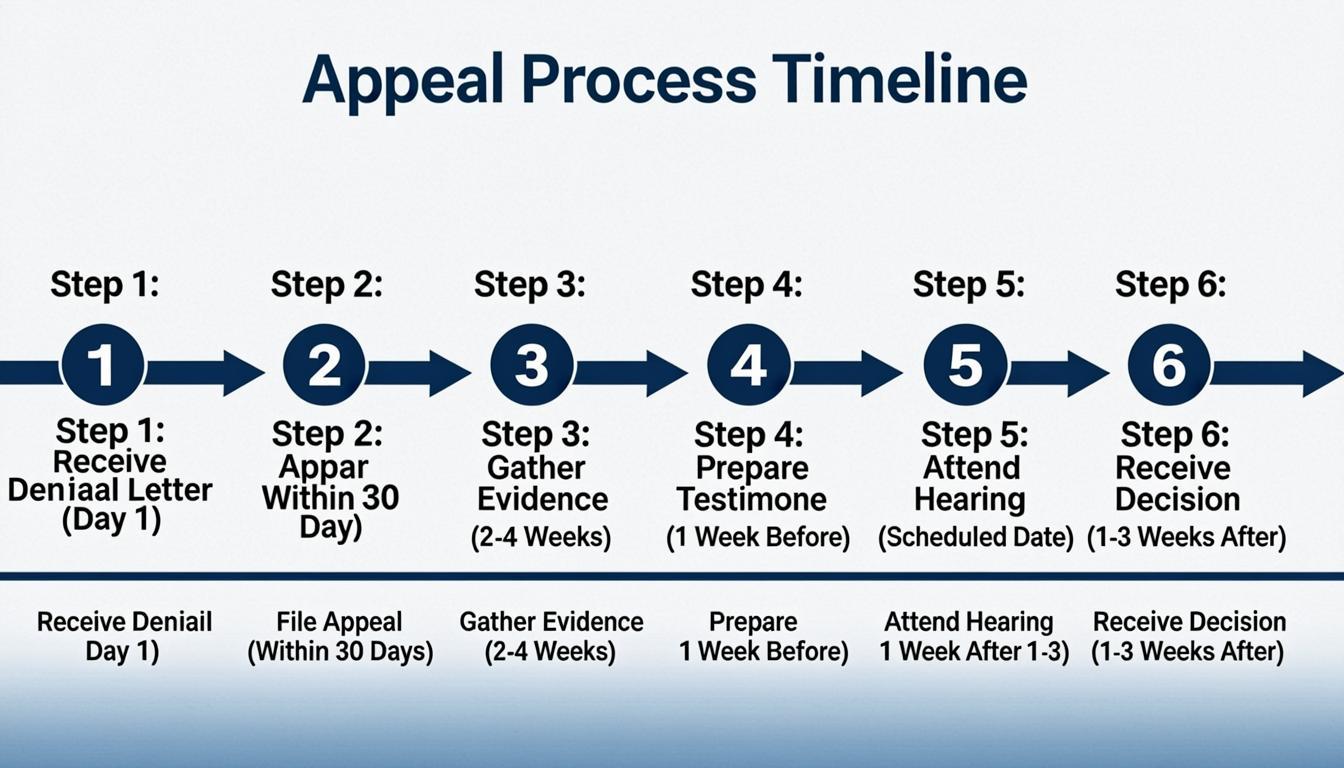
After you file your appeal, you will receive a hearing notice in the mail — or sometimes by email, depending on your state. This document is your roadmap. It tells you the date, time, and format of the hearing, the specific issues that will be decided, and any deadlines for submitting evidence or witness lists before the hearing.
Pay close attention to these details on your notice:
- Hearing format: Most unemployment hearings happen over the phone. Some states are now using video hearings via Zoom or similar platforms. A small number still hold in-person hearings. The format affects how you prepare, so note this carefully.
- Issues to be decided: The notice will specify the exact legal questions the judge needs to answer. This might be "Did the claimant voluntarily quit without good cause?" or "Was the claimant discharged for misconduct?" Your entire argument should revolve around these specific issues — do not wander into unrelated territory.
- Evidence submission deadline: Many states require you to submit copies of your evidence to both the hearing office and your employer before the hearing date. If you miss this deadline, the judge might refuse to consider your documents, even if they are critical to your case.
- Appeal file or exhibit list: Some states include a copy of the documents already in your file. Review these carefully because this is what the judge has already seen. You need to know what your employer submitted so you can prepare your rebuttal.
Mark the hearing date on your calendar immediately. Missing your hearing is the single fastest way to lose your appeal, and rescheduling is extremely difficult. If a genuine emergency comes up, contact the hearing office before the scheduled time to request a continuance — do not simply fail to appear.
Step 2: Gather and Organize Your Evidence
Evidence is the backbone of a successful appeal. The judge makes their decision based on the evidence and testimony presented at the hearing, not on sympathy or fairness. If you have strong documents that support your version of events, you have a real shot at winning. Without them, you are relying solely on your word against your employer's word — and that is a tough position to be in.
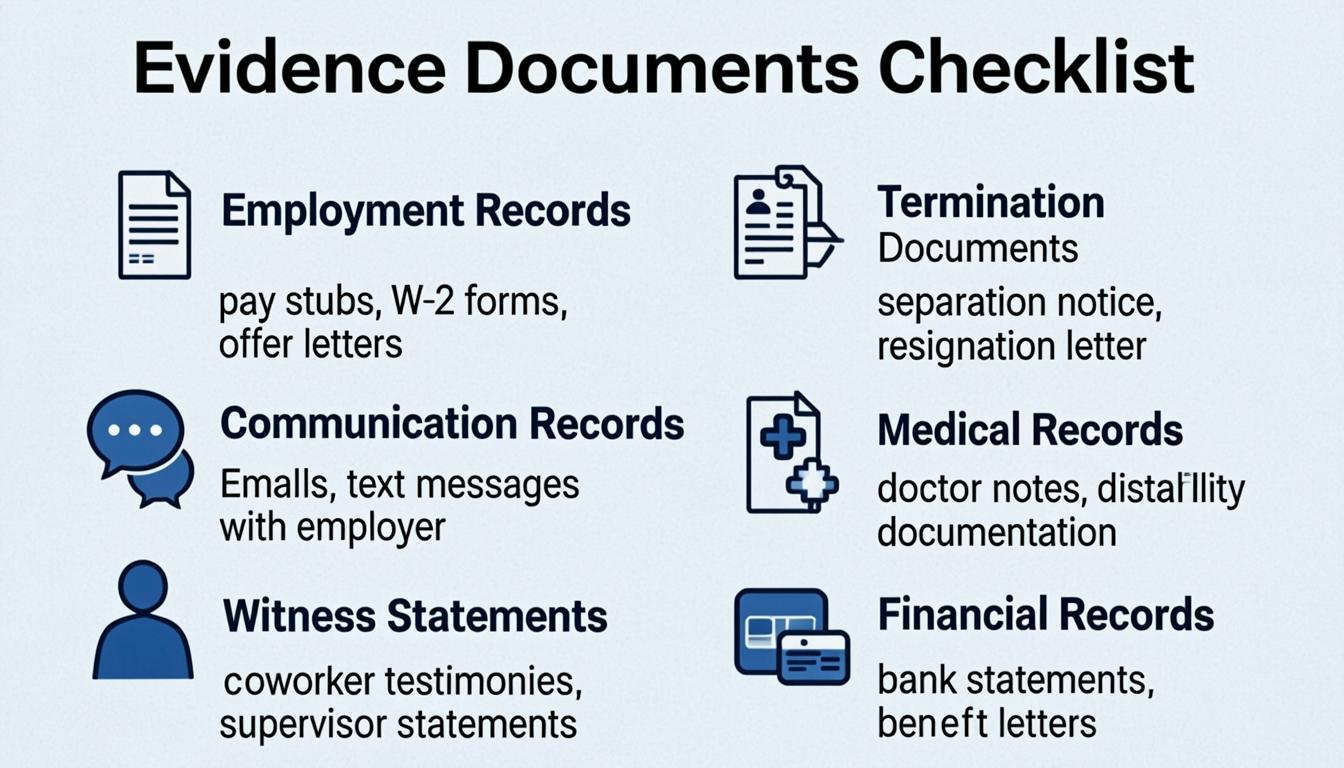
Here are the types of evidence that make the biggest difference at an unemployment hearing:
Employment documents: Your offer letter, employment contract, employee handbook, performance reviews, written warnings or disciplinary notices, and your separation or termination letter. These documents establish the terms of your employment and any progressive discipline your employer may or may not have followed.
Communications: Print out and save emails, text messages, Slack messages, or any other written communication that supports your case. This includes messages where your manager acknowledged your good performance, communications where you raised concerns about workplace issues, or any written notice you gave about problems at work. Text messages are particularly powerful because they are timestamped and difficult to dispute.
Medical documentation: If your separation involved a medical issue — a workplace injury, a doctor-ordered leave, or a disability accommodation — medical records and doctor's notes are essential. Redact personal medical details that are not relevant to the unemployment issue, but provide enough to show that your health situation was legitimate and documented.
Witness information: Coworkers who saw what happened, supervisors who can corroborate your version of events, or HR staff who were involved in your separation. Witnesses who testify at the hearing carry more weight than written statements, so try to get witnesses to appear live rather than just submitting a written statement. Give your witnesses plenty of advance notice and explain what questions they will be asked.
Company policies and handbooks: If your employer claims you violated a specific policy, get a copy of that policy. Often, employers cannot produce the actual written policy they claim you violated, and that weakens their case significantly. If the policy was never clearly communicated to you, that is even better for your appeal.
Organize everything in a folder or binder with labeled tabs so you can find any document quickly during the hearing. When the judge asks "Do you have a document that shows X?" you want to be able to say "Yes, I do" and find it within seconds, not while shuffling through a messy pile of papers.
Step 3: Build Your Argument
Having evidence is one thing. Knowing how to present it in a logical, persuasive sequence is another. The best approach is to structure your argument like a story — a clear, chronological narrative that leads the judge to the conclusion that you qualify for benefits.
Start with an opening statement that takes two to three minutes at most. Tell the judge who you are, how long you worked for the employer, and briefly state why you believe you are eligible for benefits. For example: "I worked at ABC Company for three years as a warehouse associate. I was terminated on March 15th, and I believe the termination was not for misconduct. My performance reviews were consistently positive, and I was never given a written warning about the issue my employer is now raising. I will present evidence to support this."
Next, present the facts in chronological order. Start from the beginning of the relevant events and walk through what happened step by step. Refer to specific documents by name and date: "As shown in my performance review dated January 12th, my manager rated my work as exceeding expectations." This is much more effective than vague statements like "I was a good employee."
Then address the legal standard directly. If the issue is whether you quit with good cause, explain how your situation meets your state's definition of good cause. If the issue is misconduct, explain why your actions do not meet the legal definition of misconduct. Citing the specific legal standard shows the judge that you understand what matters in the decision. To understand what the judge will be evaluating, our article on common disqualifications from unemployment benefits covers the exact criteria most states use.
Finish with a closing statement that takes one to two minutes. Summarize your strongest two or three points and ask the judge to reverse the denial. Keep it brief and confident — do not beg, do not get emotional, and do not introduce new arguments that you did not raise earlier in the hearing.
Step 4: Prepare for the Hearing Format
The format of your hearing — telephone, video, or in-person — shapes how you need to prepare. Each format has its own practical considerations that can make or break your presentation.

Telephone Hearings
Telephone hearings are by far the most common format. They feel less formal, but the judge is taking everything down just as seriously as an in-person proceeding. Here is how to prepare:
- Find a quiet, private room with no background noise, music, or other people talking. The judge needs to hear you clearly, and background noise makes a terrible impression.
- Use a landline if possible. Cell phones drop calls, and losing your connection mid-hearing is a disaster. If you must use a cell phone, make sure you have full bars and a charger plugged in.
- Test your setup before the hearing day. Call a friend from the same phone and room you plan to use. Ask if they can hear you clearly and if there is any echo or static.
- Have all your documents spread out on a table in front of you, organized in the order you plan to reference them. During a phone hearing, you cannot show documents to the judge, so you need to describe them clearly: "I have a written warning dated February 3rd that states..."
- Keep a notepad handy to write down questions the judge or your employer's representative asks so you can address each one fully.
- Speak slowly and clearly. It is natural to rush when you are nervous, but the judge is taking notes and needs time to write everything down. Pause after important points.
Video Hearings
An increasing number of states are conducting hearings over Zoom, Microsoft Teams, or their own video platforms. If your hearing is by video:
- Test your camera, microphone, and internet connection at least a day before the hearing. Download the required software in advance — do not wait until five minutes before the hearing starts.
- Dress as you would for an in-person hearing. Business casual is appropriate. You want to look like someone taking the process seriously.
- Set up a clean, professional background. A blank wall or a tidy home office is fine. Avoid bedrooms, kitchens, or cluttered spaces that look unprofessional on camera.
- Have your documents both on paper and on screen if possible. You may be able to share your screen to show the judge a document directly, which is a significant advantage over phone hearings.
- Look at the camera, not yourself. It feels unnatural, but looking directly at your webcam creates the equivalent of eye contact with the judge.
In-Person Hearings
In-person hearings are rare now but still happen in some states. If you have one, arrive at least 15 minutes early, bring multiple copies of all your documents (one for you, one for the judge, one for the employer), and dress in business casual attire. Bring a pen and notepad. Turn off your cell phone before entering the hearing room.
Step 5: Know What to Expect During the Hearing
Understanding the flow of the hearing ahead of time takes away a lot of the anxiety. While every judge runs things slightly differently, nearly all unemployment appeal hearings follow the same general structure:
1. Introduction and swearing in: The judge introduces themselves, explains the issues being decided, confirms who is present, and places everyone under oath. You will be asked to state your name and may need to spell it.
2. Opening statements: Both sides get a chance to briefly state their position. Keep yours short and focused — two to three minutes maximum.
3. Testimony and questioning: This is the longest portion of the hearing. The party with the burden of proof usually goes first. If you were fired, your employer typically has the burden of proving misconduct. If you quit, you have the burden of proving good cause. Each side presents their testimony, the judge asks questions, and then the other side gets to cross-examine. When your employer's representative is testifying, listen carefully — you may hear them say things that are inaccurate or exaggerated, and you will get a chance to challenge those claims.
4. Rebuttal: After the initial round of testimony, each side can address new points that came up during questioning. Do not just repeat what you already said — only use rebuttal to respond to specific claims the other side made that you have not already addressed.
5. Closing statements: Both sides summarize their strongest points. This is your final chance to make an impression, so hit your one or two best arguments and sit down.
6. Decision: The judge rarely announces the decision at the hearing itself. Most decisions are mailed within two to four weeks after the hearing. Some states post decisions online through your claimant portal.
Most hearings last between 30 and 60 minutes, though complex cases can run longer. Plan to be available for at least 90 minutes just in case.
Step 6: Tips for Testifying Effectively
How you say something matters almost as much as what you say. Judges hear hundreds of these cases, and they develop a sense for who is credible and who is not. Here are the rules that experienced representatives follow every time:
- Answer only the question asked. If the judge asks "What was your last date of work?" say "March 15th." Do not add context, explanations, or additional information unless you are specifically asked. Volunteering extra information is one of the most common ways people hurt their own case.
- Tell the truth, even when it hurts. If something does not look great for your case, acknowledge it briefly and move on. Judges respect honesty, and getting caught in an exaggeration or lie destroys your credibility on everything else.
- Do not guess. If you do not remember a specific date or detail, say "I don't recall" rather than guessing. A wrong guess can be contradicted by documents and make you look unreliable.
- Stay calm and professional. Your former employer's representative may say things that are unfair, inaccurate, or even infuriating. Do not interrupt, do not raise your voice, and do not argue. Wait your turn, then calmly correct the record.
- Use specific dates and facts. "I received a written warning on February 3rd" is powerful. "They wrote me up sometime in February" is weak. Specificity signals credibility.
- Do not interrupt the judge. This should go without saying, but it happens more often than you would think. Let the judge finish their question completely before you start answering.
Common Mistakes That Lose Hearings
After thousands of unemployment hearings, certain patterns emerge. These are the most common mistakes that cause people to lose appeals they should have won:
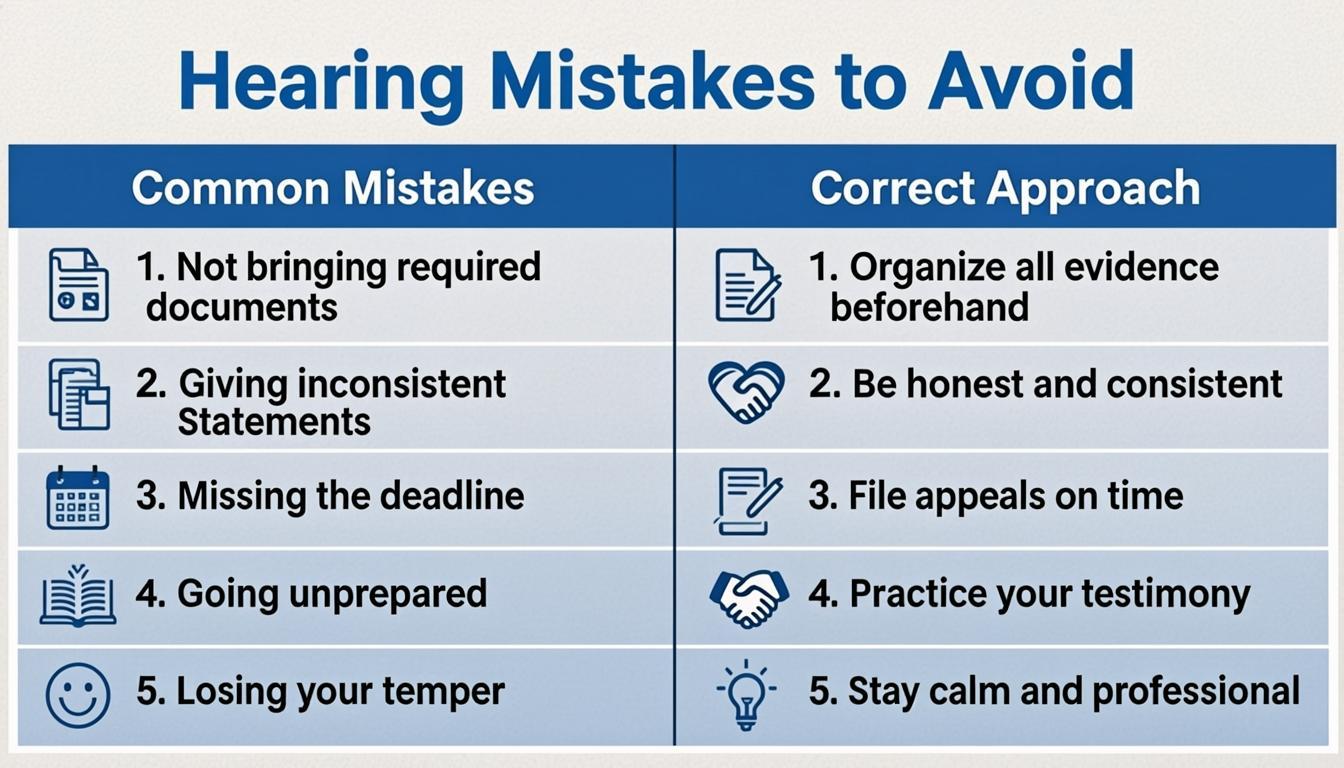
Missing the hearing entirely. This is the number one mistake. If you do not show up — or do not call in for a phone hearing — the judge will almost always rule against you by default. No excuse is good enough unless you contacted the hearing office before the hearing and got a continuance approved. Put the hearing on multiple calendars, set two alarms, and confirm the date and time a day before.
Getting emotional or angry. It is completely understandable to feel angry about losing your job and being denied benefits. But losing your temper at the hearing — arguing with the judge, shouting at your employer's representative, or breaking down in tears — hurts your case. The judge is making a legal decision based on evidence, not based on who seems the most upset. Stay composed, take deep breaths, and remember that you can always address unfair statements when it is your turn to speak.
Volunteering too much information. This is the most subtle and most damaging mistake. When the judge asks a narrow question, some people answer it and then keep talking, bringing up irrelevant details, past grievances, or information that actually hurts their case. Every word you say at the hearing becomes part of the record. Answer the question, stop talking, and wait for the next question.
Failing to object to inappropriate questions. If your employer's representative asks you about something that is not relevant to the issues being decided — like your personal medical history, your family situation, or events from years before your separation — you can politely object. Say "Objection, that question is not relevant to the issue before the judge." The judge will either sustain your objection and tell the other side to move on, or overrule it and allow the question. Either way, objecting shows that you understand the process.
Not bringing any evidence. Showing up to a hearing with nothing but your verbal testimony is almost always a losing strategy. Your employer will bring documents, and their version of events will look more convincing because it is supported by paper. Bring your evidence, refer to it during your testimony, and make the judge's job easier by showing rather than just telling. These preparation failures are similar to the errors covered in our guide about unemployment application mistakes that delay your claim — the same pattern of poor preparation causes problems at every stage of the process.
Failing to submit evidence before the deadline. Many states have a pre-hearing evidence submission deadline. If you show up with documents you never submitted beforehand, the judge may refuse to consider them, especially if your employer has not had a chance to review them. Check your hearing notice for any submission deadlines and follow them strictly.
Do You Need a Lawyer?
You are not legally required to have an attorney or representative at your unemployment hearing, and many claimants successfully represent themselves. However, there are situations where having legal help makes a real difference:
Consider getting a lawyer if:
- Your employer is represented by an attorney or a third-party unemployment cost control company. These representatives handle hundreds of hearings and know every legal argument and procedural tactic. Going against them alone is like playing a sport against a professional while you are still learning the rules.
- Your case involves complex legal issues like constructive discharge, whistleblower protections, or disability accommodation disputes.
- The amount of benefits at stake is large — if you stand to lose six months or more of benefit payments, the cost of an attorney may be worth it.
- You already lost at the lower-level hearing and are appealing to a board of review or court, where procedural rules are much stricter.
Where to find help: Legal aid organizations in most states provide free or low-cost representation for unemployment appeals. Your state's bar association may have a referral service with attorneys who specialize in employment law. Some attorneys offer free initial consultations, and a few work on contingency for unemployment cases. Law school clinics sometimes take these cases as well. Do not wait until the last minute — reach out to these resources as soon as you file your appeal because their caseloads fill up quickly.
What Happens After the Hearing?
After the hearing ends, the waiting begins. Most judges issue their written decision within two to four weeks, though some states are faster and others can take longer during busy periods. The decision will be mailed to you at the address on file, and many states also post it on your online claimant portal.
If you win: Congratulations — the judge has reversed the denial, and you will receive benefits retroactive to the date you first became eligible. This means you will get a lump-sum payment for all the weeks you should have been receiving benefits while your appeal was pending. Keep certifying for benefits every week or every two weeks as required by your state, and make sure your contact and payment information is up to date. To make sure you get the full amount you are entitled to, read our guide on how to maximize your unemployment benefit period and total payments.
If you lose: You have options. Every state allows you to appeal the judge's decision to a higher review board, and from there you can sometimes appeal to the state court system. The deadline for this next level of appeal is typically 15 to 30 days from the date of the decision — check the decision letter carefully for the exact deadline. At this level, you generally need to show that the administrative law judge made an error of law or that the decision was not supported by the evidence in the record. You cannot introduce new evidence at this stage — the review board only considers what was presented at the hearing. Legal aid organizations and employment attorneys are especially helpful at this stage because the procedural rules are stricter.
Even if you lose your appeal entirely, you can still file a new unemployment claim if you become unemployed again from a different employer. The denial only affects the specific claim you appealed, not future claims. And if your financial situation changes, you may qualify for other assistance programs — our article on what to do when your unemployment benefits run out covers those safety net options in detail.
State-Specific Differences to Know
While the general process is similar across the country, each state has its own unemployment insurance agency, its own set of rules, and its own quirks. Here are some of the most important state-level variations to be aware of:
Burden of proof: In most states, if you were fired, the employer has the burden of proving misconduct. If you quit, you have the burden of proving good cause. But a few states flip this for certain situations, so check your state's specific rules.
Good cause standards: What counts as good cause for quitting varies dramatically. Some states recognize domestic violence as good cause; others do not without specific evidence. Some states consider a significant commute increase as good cause; others require it to be extreme. Medical reasons are generally accepted but the documentation requirements differ.
Evidence submission rules: Some states allow you to introduce new evidence at the hearing without pre-submitting it. Others require all evidence to be submitted days or even weeks in advance. Failing to follow your state's evidence rules can result in the judge refusing to consider your most important documents.
Hearing timeline: Most states hold appeal hearings within 30 to 60 days of filing the appeal, but some are much slower. If your state is backlogged, keep certifying for benefits in the meantime so you can receive back pay if you win.
Waiting week: Some states have a waiting week before benefits begin, and some have eliminated it. This affects your back pay calculation if you win your appeal. Our article on the waiting week for unemployment and which states have eliminated it explains this in detail.
Always check your own state's unemployment insurance website for the specific rules and procedures that apply to your hearing. The general advice in this article applies to the vast majority of cases, but state-specific rules always take precedence.
Your Preparation Checklist
Use this checklist in the days leading up to your hearing to make sure you have not overlooked anything critical:
- Read your hearing notice completely and confirmed the date, time, and format
- Identified the specific issues the judge will decide
- Reviewed all documents in the appeal file or exhibit list
- Gathered employment documents: offer letter, reviews, warnings, separation letter
- Printed and organized emails, text messages, and other communications
- Collected any medical documentation relevant to your case
- Contacted potential witnesses and confirmed their availability
- Submitted all evidence by the pre-hearing deadline (if required by your state)
- Prepared a two-to-three minute opening statement
- Organized your argument chronologically with specific document references
- Practiced answering questions out loud — especially the hard ones
- Tested your phone or video setup if the hearing is remote
- Arranged a quiet space where you will not be interrupted during the hearing
- Set multiple reminders for the hearing date and time
- Reviewed what to do if you win or lose so you are prepared for either outcome
If you can check off every item on this list, you are in a strong position. You have done more preparation than the vast majority of claimants, and that preparation translates directly into a better chance of winning.
Do I need a lawyer for my unemployment hearing?
You are not required to have a lawyer, and many claimants represent themselves successfully, especially for straightforward cases. However, if your employer has legal representation, your case involves complex legal issues, or a large amount of benefits is at stake, getting an attorney significantly improves your chances. Legal aid organizations in most states offer free help for unemployment appeals, so cost should not prevent you from at least exploring your options.
How long does an unemployment hearing typically last?
Most hearings last between 30 minutes and one hour. Complex cases with multiple witnesses or extensive documentation can run longer. Plan to be available for at least 90 minutes so you are not watching the clock during the hearing, which can make you rush your answers.
What if my employer does not show up?
If your employer fails to appear at the hearing, this is very favorable for you. The judge will proceed with only your testimony and evidence, and in most states, the employer's written protest is the only thing considered on their side. Without their representative present to cross-examine you and present testimony, your version of events goes largely unchallenged.
Can I submit new evidence at the hearing?
This depends on your state. Many states require evidence to be submitted before the hearing date, sometimes days or weeks in advance. Other states are more flexible and allow you to introduce documents at the hearing itself. If you discover important evidence after the deadline, bring it to the hearing anyway and ask the judge to accept it — the worst that happens is they say no, but they often allow it if the other side has a chance to review it.
Will I receive back pay if I win my appeal?
Yes, this is one of the most important things to understand about the appeal process. If you win your appeal, you will receive benefits retroactive to the date you first became eligible. This can amount to thousands of dollars in lump-sum back pay. That is why it is critical to keep certifying for benefits every week or every two weeks while your appeal is pending — if you stop certifying, you may not receive credit for those weeks even if you win.
What if I cannot afford an attorney?
Several options are available. Legal aid organizations provide free legal representation for income-qualified individuals in most states. Your state bar association may offer a referral service with reduced-fee initial consultations. Some employment attorneys work on contingency, meaning they only get paid if you win. Law school clinical programs also sometimes handle unemployment appeals as part of their training. Reach out as early as possible because these resources have limited capacity and high demand.
Can I get unemployment if I quit my job?
In most states, quitting voluntarily disqualifies you unless you had good cause. Good cause typically includes unsafe working conditions, significant changes to your job duties or pay, domestic violence situations, and certain medical reasons. Each state has its own list of qualifying reasons. Our comprehensive guide on whether you can get unemployment benefits if you quit your job covers every state's specific rules.
How soon after filing an appeal will my hearing be scheduled?
Most states schedule appeal hearings within 30 to 60 days of receiving your appeal. Some states are faster — scheduling within two to three weeks — while others with high caseloads may take longer. Continue certifying for benefits while you wait, because if you win, you will receive back pay for all eligible weeks during the waiting period.